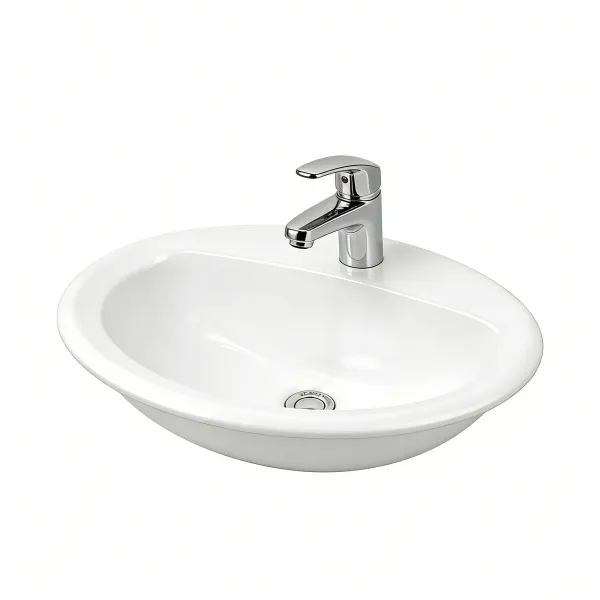
Bathroom sanitaryware such as ceramic washbasins conventionally suffer from persistent challenges: surface stains, bacterial growth, and frequent cleaning cycles. Traditional glazing techniques, while functional, often result in porous surfaces with water absorption rates exceeding 0.5%, creating micro-environments conducive to grime and mold accumulation. This translates into increased maintenance costs and hygiene risks, especially in high-traffic environments like hotels, hospitals, and commercial kitchens.
Nanocoating, or nano-glazing technology, revolutionizes ceramic surface properties by engineering an ultra-smooth, densely packed nanoparticle layer. This microscopic architecture creates a surface with a water absorption rate lower than 0.1%, drastically below the 0.5%-1.5% typical for traditional glazes. The coating mimics the “lotus leaf effect” — an inherently hydrophobic phenomenon where water droplets bead and roll off, carrying away dirt particles efficiently.
The surface roughness, measured by Atomic Force Microscopy (AFM), drops from an average Ra of 0.3 µm in conventional glazes to under 0.05 µm with nanocoating. This enhanced smoothness reduces adhesion forces for contaminants including oils, biofilms, and lime scale. Moreover, the ceramic’s chemical resistance towards acids and alkalis is significantly improved, extending the lifespan of sanitary fixtures under aggressive cleaning agents.
| Metric | Traditional Glaze | Nanocoating Technology |
|---|---|---|
| Water Absorption Rate | 0.5% - 1.5% | < 0.1% |
| Surface Roughness (Ra) | ~0.3 µm | < 0.05 µm |
| Stain Adhesion Strength | High | Significantly Reduced |
| Resistance to Acid/Alkali | Moderate | Enhanced |
The robustness and hygiene benefits of nanocoated ceramics make them ideal for commercial and institutional settings demanding repeated sanitation cycles and high usage intensity:

Despite nanocoating’s self-cleaning propensity, periodic maintenance optimizes longevity and performance. Recommended practices include:

 60
|
60
|
 G1/2 interface shower installation
home shower replacement tutorial
tool - free shower installation
handheld shower installation guide
bathroom renovation practice
G1/2 interface shower installation
home shower replacement tutorial
tool - free shower installation
handheld shower installation guide
bathroom renovation practice
 75
|
nano glazing technology
bathroom fixture cleaning
stain resistance
mold prevention
acid-alkali durability
75
|
nano glazing technology
bathroom fixture cleaning
stain resistance
mold prevention
acid-alkali durability
 262
|
Low water pressure shower solutions
Booster handheld shower head recommendations
Water-saving shower equipment
Handheld shower spray modes
Low water pressure booster valve principle
338
|
low water pressure shower solution
handheld shower with booster valve
water-saving shower head
shower pressure test method
bathroom fixture upgrade
273
|
Ceramic washbasin selection
Ultra - thin edge ceramic washbasin
High - temperature fired ceramic
Hotel bathroom design
Nano - glaze anti - soiling
262
|
Low water pressure shower solutions
Booster handheld shower head recommendations
Water-saving shower equipment
Handheld shower spray modes
Low water pressure booster valve principle
338
|
low water pressure shower solution
handheld shower with booster valve
water-saving shower head
shower pressure test method
bathroom fixture upgrade
273
|
Ceramic washbasin selection
Ultra - thin edge ceramic washbasin
High - temperature fired ceramic
Hotel bathroom design
Nano - glaze anti - soiling