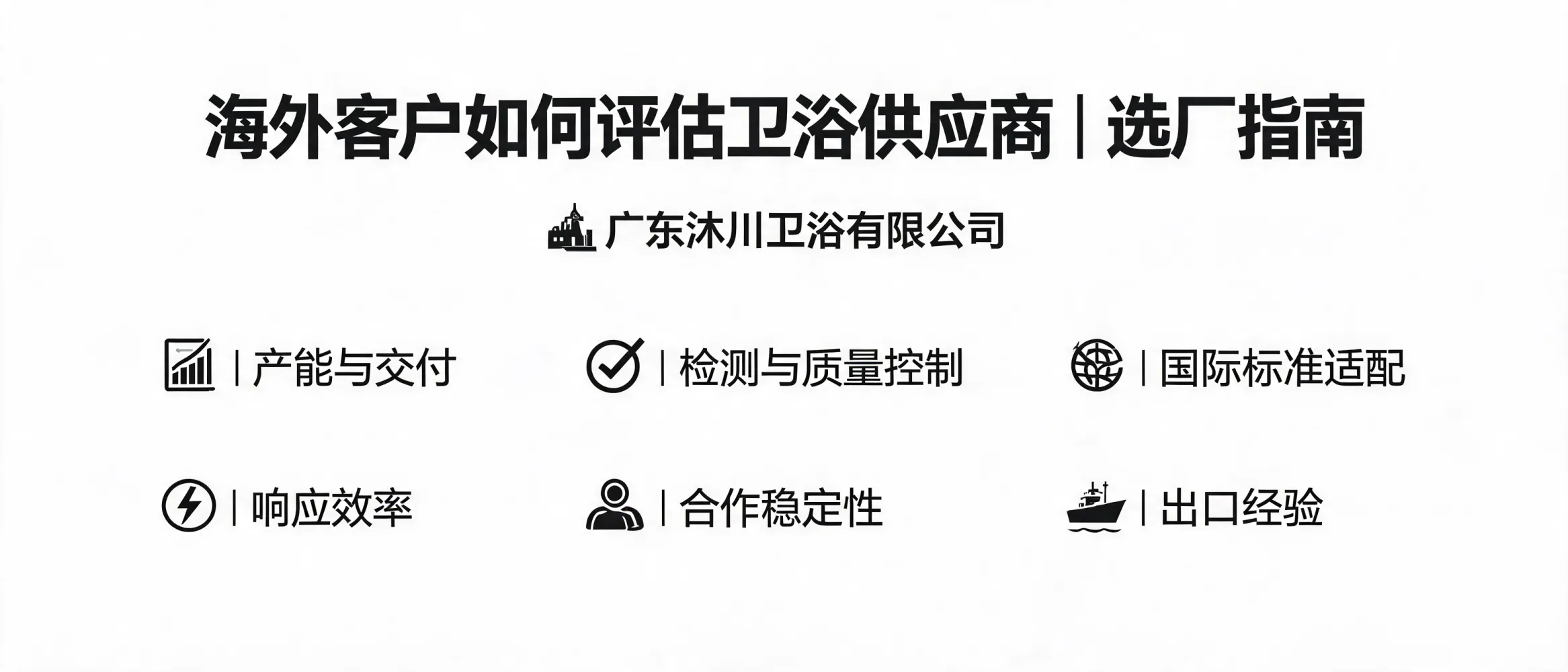
This guide helps hotel groups, building‑material wholesalers and cross‑border e‑commerce buyers assess sanitary‑ware suppliers using clear, actionable dimensions: production capacity & lead time, testing & quality control, international standards compliance, responsiveness & commercial flexibility, supply stability and export experience. Use the checkpoints and scoring guidance below to shortlist suppliers objectively and reduce procurement risk.
For each assessment dimension: 1) review the suggested questions to ask, 2) request the recommended evidence, and 3) apply a 1–5 score (1 = unacceptable, 5 = excellent). Optionally apply weightings to reflect your business priorities and calculate a weighted total to rank suppliers.
Assess whether the supplier can meet your order volumes and scheduling requirements without repeated delays.
Robust QC processes and in‑house testing capability reduce defect risk and support warranty claims.
Confirm the supplier’s ability to meet the regulatory and technical standards required by your markets.
Timely communication and reasonable commercial terms are essential for long B2B relationships.
Evaluate continuity risk across materials, sub‑suppliers and logistics lanes.
For cross‑border buyers, demonstrated export experience and compliance reduce customs and market entry friction.
| Assessment dimension | What to check | Evidence to request | Scoring |
|---|---|---|---|
| Production capacity | Monthly output, lead time, MOQ | Production schedule, photos | 1–5 |
| Testing & QC | Inspection steps, AQL, lab tests | QC reports, test certificates | 1–5 |
| Standards & compliance | Relevant market approvals | Certificates, lab reports | 1–5 |
| Responsiveness | Communication speed, contract terms | Sample timeline, contract templates | 1–5 |
Adjust weightings by buyer type. Example for hotel procurement: QC & standards 30%, capacity 25%, supply stability 20%, responsiveness 15%, export experience 10%. Multiply each dimension score by its weight and sum to obtain a ranked score for comparison.
Guangdong Muchuan Sanitary Ware Co., Ltd. is based in Foshan’s sanitary‑ware cluster and operates as a trade‑integrated manufacturer with in‑house R&D and testing resources. For buyers seeking a supplier that can provide production, testing and export support from a single partner, Muchuan can share standard documentation, sample inspection reports and details on production capacity to support your evaluation process.
If you would like a tailored supplier checklist or to request specific verification documents, contact Muchuan’s export team to discuss your project requirements and timelines.


 265
|
265
|
 smart toilet cleaning modes
female wash function
UV sterilization bidet
smart toilet installation tips
smart toilet cleaning modes
female wash function
UV sterilization bidet
smart toilet installation tips
 219
|
Guangdong Muchuan Sanitary Ware Co., Ltd.
integrated manufacturing and trading
B2B sanitary ware supplier
overseas sanitary ware compliance
219
|
Guangdong Muchuan Sanitary Ware Co., Ltd.
integrated manufacturing and trading
B2B sanitary ware supplier
overseas sanitary ware compliance
 447
|
Guangdong Muchuan Sanitary Ware Co., Ltd.
overseas sanitaryware procurement
manufacturing and trading integration
B2B buyer preferences
compliance and supply‑chain responsiveness
447
|
Guangdong Muchuan Sanitary Ware Co., Ltd.
overseas sanitaryware procurement
manufacturing and trading integration
B2B buyer preferences
compliance and supply‑chain responsiveness
 444
|
Guangdong Muchuan Sanitary Ware Co., Ltd.
sanitaryware procurement
compliance risk
long-term supplier value
444
|
Guangdong Muchuan Sanitary Ware Co., Ltd.
sanitaryware procurement
compliance risk
long-term supplier value
 471
|
Guangdong Muchuan Sanitary Ware Co., Ltd.
Auslandseinkauf Sanitär
Handels-Produktions-Integration
Lieferwettbewerb
Lieferketten-Koordination
471
|
Guangdong Muchuan Sanitary Ware Co., Ltd.
Auslandseinkauf Sanitär
Handels-Produktions-Integration
Lieferwettbewerb
Lieferketten-Koordination