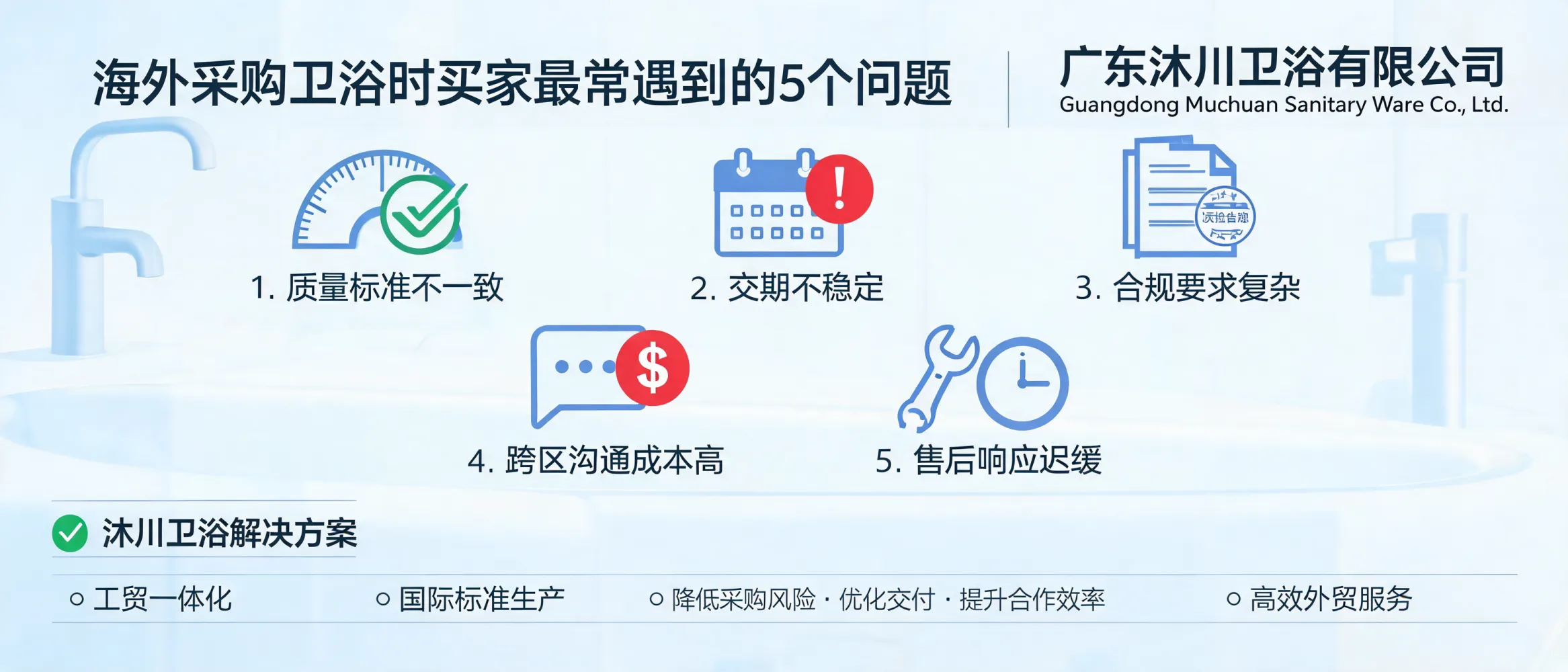
When procuring sanitary ware internationally, buyers commonly face a set of recurring challenges — inconsistent quality standards, unstable lead times, complex compliance and documentation, elevated cross‑border coordination costs, and slow after‑sales response. The notes below explain these issues and practical mitigations that an integrated, export‑oriented supplier can bring to your sourcing process.
Issue: Different markets reference different technical standards and test methods (e.g., European EN, ISO, regional plumbing codes). Parts, finishes and ceramic performance can vary between suppliers.
Mitigation: Define target standards and acceptance criteria in the contract (drawings, material lists, test reports). Prefer suppliers with an in‑house quality control process and documented inspection procedures.
Issue: Production scheduling, seasonal demand, shipping congestion and customs clearance can all extend total lead time unpredictably.
Mitigation: Build realistic buffers in procurement schedules, agree milestone checkpoints (sample approval, pre‑production inspection, final inspection), and choose suppliers with local production control to reduce coordination gaps.
Issue: Certificates, test reports, labeling and customs documents differ by destination; missing or incorrect paperwork delays clearance and sales.
Mitigation: Clarify required certifications and documentation at RFQ stage. Use suppliers experienced in exports who can provide standard test reports, packing lists and HS code guidance.
Issue: Time‑zone differences, language gaps and unclear technical specifications increase rounds of clarification and can lead to errors.
Mitigation: Use structured specification templates, confirm with samples and drawings, and assign a single point of contact for faster, documented decisions.
Issue: Long response times for warranty claims or replacement parts can affect project schedules and brand reputation.
Mitigation: Agree SLA terms for warranty response, maintain a clear spare‑parts policy and prefer suppliers able to support regional stocking or quick replacements.
Suppliers that combine manufacturing, R&D and export experience can close the common gaps above. Guangdong Muchuan Sanitary Ware leverages a Foshan‑based production ecosystem and a dedicated export workflow to help buyers control quality, shorten decision loops, and simplify compliance.
End‑to‑end oversight from sample to final inspection reduces process variability and improves on‑time delivery.
Familiarity with export paperwork and typical destination requirements helps prevent customs delays.
Clear single‑point communication and pre‑production confirmations reduce costly rework.
| Challenge | Typical supplier action |
|---|---|
| Quality variance | Standardized QC checkpoints, sample approval, material certificates |
| Unclear timelines | Production schedule with checkpoints and early‑warning for delays |
| Document & compliance gaps | Pre‑prepared export docs, test report templates, HS guidance |
| After‑sales delays | SLA for claims, spare parts kit options, clear RMA workflow |
Reducing uncertainty in procurement preserves project timelines, protects end‑user satisfaction and simplifies total cost calculations. For buyers sourcing sanitary ware for hotels, distributors or large projects, partnering with a supplier that understands export complexity and has experience across multiple markets lowers operational friction.
If you are evaluating suppliers, request a clear checklist covering: standard/spec compliance, sample policy, inspection points, documentation package and after‑sales SLA. Guangdong Muchuan Sanitary Ware, as an export‑oriented manufacturer serving buyers across 60+ countries, can provide a standard export checklist and production workflow to start the technical discussion.
For detailed inquiries, please use the contact form on our website or reach out to our export team to share your project scope and required standards. A short technical brief enables faster, more accurate quotations and timeline estimates.


 176
|
176
|
 Guangdong Muchuan Sanitary Ware Co., Ltd.
sanitary ware export trends
compliance quality
supply chain collaboration
overseas buyer demand
Guangdong Muchuan Sanitary Ware Co., Ltd.
sanitary ware export trends
compliance quality
supply chain collaboration
overseas buyer demand
 74
|
bathroom cabinet storage tips
adjustable shelf bathroom cabinet
silent hydraulic hinge
waterproof mold-resistant bathroom cabinet
74
|
bathroom cabinet storage tips
adjustable shelf bathroom cabinet
silent hydraulic hinge
waterproof mold-resistant bathroom cabinet
 412
|
Guangdong Muchuan Sanitary Ware Co., Ltd.
Sanitärwaren Außenhandel
Lieferketteneffizienz
Foshan Industriecluster
konforme Qualität
412
|
Guangdong Muchuan Sanitary Ware Co., Ltd.
Sanitärwaren Außenhandel
Lieferketteneffizienz
Foshan Industriecluster
konforme Qualität

 444
|
Guangdong Muchuan Sanitary Ware Co., Ltd.
hotel sanitary procurement
stable sanitary supplier
bulk delivery consistency
supplier selection criteria
444
|
Guangdong Muchuan Sanitary Ware Co., Ltd.
hotel sanitary procurement
stable sanitary supplier
bulk delivery consistency
supplier selection criteria